

Welcome to Weekender № 6.
As we mentioned in last week’s newsletter, we are in the thick of a phase known as "Tax-Loss Harvesting."
This is the window where funds and retail investors dump their losing positions to offset capital gains taxes before the books close on the year. This creates artificial selling pressure. Fundamentally sound companies are being sold off not because their business is failing, but because their stock price is down 20 percent and portfolio managers need the tax write-off.
Why it matters: This mechanical selling creates a distortion. It offers entry points into high-quality, cash-rich companies that we likely won't see in January.
When the calendar flips and the selling pressure evaporates, these stocks often experience a rebound known as the "January Effect." We are currently hunting for companies unfairly punished by the calendar.
Quick Hits
- The Index Effect: Shares of LB Pharmaceuticals (LBRX) rose 21 percent. The company is set to join the Russell 2000 and 3000 indices on Dec. 22, triggering automatic buying from index funds.
- Green Light: Satellos Bioscience (MSCL) received F.D.A. clearance for its Phase 2 Duchenne muscular dystrophy trial, clearing a major regulatory hurdle.
- Outlook: Top Wealth Group (TWG) surged 68 percent after management projected strong profit growth for the coming year.
- Dilution: Fulcrum Therapeutics (FULC) announced a $150 million public offering. The stock dipped on the news, as the move dilutes current shareholders.
- Launch: Citius Oncology (CTOR) raised $18 million to support the commercial rollout of its new drug, LYMPHIR.
- The Founder’s Bet: Nerdy Inc. (NRDY) C.E.O. Charles Cohn invested nearly $250,000 of personal capital into his company’s stock on Dec. 5, a rare move in a sector where executives typically sell options. This open-market purchase signals that Cohn views the current share price as disconnected from the company's actual turnaround metrics.
- The Bonus Play: Adverum Biotechnologies (ADVM) C.E.O. Laurent Fischer bought roughly 117,000 shares on Dec. 8, paying a premium over the company’s pending cash acquisition offer. By paying more than the guaranteed buyout price, Fischer is effectively betting that positive clinical data will trigger the deal’s lucrative "Contingent Value Right" bonus.
Scorecard
Key stats on the market's movers from our proprietary quantitative model.
The Hurricane Hedge: HCI Group (HCI) CapScore: 3.8 | Rating: Accumulate (Editor’s Choice)
HCI is an insurer based in Florida, a market that many major carriers have fled due to climate risks. Yet, staying put is paying off. The company recently beat earnings expectations by roughly 160 percent.
- Why it matters: In a broken market where insurance coverage is scarce, companies with strong balance sheets can dictate pricing. The stock has consolidated recently, but we think the market is missing the bigger picture. Our price target is $207 (+20%).
The Wildcard: Barrett Business Services (BBSI) CapScore: 2.3 | Rating: Buy on Weakness
BBSI, a staffing and professional employer organization, is expanding its footprint into Nashville.
- Why it matters: While the tech sector hyperventilates over A.I. automation, the demand for human capital management remains high. BBSI’s expansion into the South suggests they see continued strength in small business hiring. A move above $36 could signal that the new expansion is driving volume.
The Kill File: ScanSource (SCSC) CapScore: 1.8 | Rating: Sell
SCSC offers a glimpse into the plumbing of the tech economy, and the pipes are leaking. The distributor recently missed revenue estimates, with sales falling nearly 5 percent as large deals stalled.
- Why it matters: Physical hardware is seeing a sharp pullback. ScanSource managed to beat earnings estimates largely through aggressive share buybacks and cost cuts—a finite strategy. Until businesses start spending on physical infrastructure again, the stock remains a "value trap."
Red Flag Radar
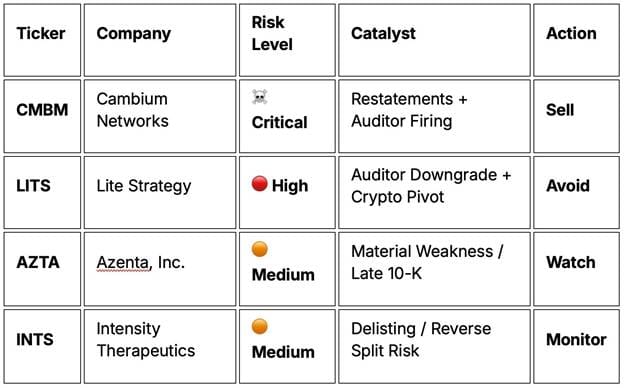
1. The Missing Numbers: Cambium Networks (CMBM) Risk: ☠️ Critical | Action: Sell
On Dec. 3, the company dismissed its auditor, Grant Thornton, and hired BDO. The timing is critical: Cambium has not filed an annual report for 2024 or quarterly reports for 2025. Management says it needs until April 2026 to restate financials. Until then, investors are looking at a "black box."
2. The Radical Pivot: Lite Strategy (LITS) Risk: 🔴 High | Action: Avoid
When a core business struggles, some companies attempt reinvention. Lite Strategy (formerly MEI Pharma) has pivoted from drug development to stockpiling Litecoin. Coinciding with this shift, they dropped Deloitte—a "Big 4" auditor—for a regional firm. This suggests a desire for less scrutiny.
3. The Classification Error: Azenta (AZTA) Risk: 🟠 Medium | Action: Watch
Azenta missed the deadline for its annual report, citing a "classification error" regarding how it booked expenses. While they admitted to a material weakness, this isn't revenue fabrication. It complicates the margin picture, but the money likely isn't missing.
4. The Dollar Threshold: Intensity Therapeutics Risk: 🟠 Medium | Action: Monitor
Trading near 50 cents, Intensity has received a delisting notice. If the price does not recover, management may perform a reverse stock split—merging shares to artificially boost the price. This is a cosmetic fix that does not address the underlying decline in value.
Spotlight

CapScore 3.5
Red Violet (RDVT) CapScore: 3.5 | Signal: Editor’s Choice
The Business of Verification
Data is often called the new oil, but raw data is useless without a refinery. Red Violet acts as that refinery.
The company uses A.I. to fuse vast amounts of data into "identity intelligence"—tools used by law enforcement and background check agencies to spot fraud. This week, the company showed why that business model is scaling efficiently, beating Wall Street’s expectations on almost every metric.
The Bottom Line: We view the current price as an entry point for a 12-to-18-month horizon.


